Are We –Is Industrial Civilization– Lost, Heading Into a Wasteland?

What is Gaia doing?

As we look to the unfolding of
the tremendous transitions
our world is entering into,
I offer hope.

All along, with Gaia, something has been going on.

Many things have been going on; surely you have remarked on some of them. Perhaps on:

  • When life on this planet in the  age of dinosaurs was practically extinguished by a century-long ash cloud from a huge meteor crash,
    life bounced back.
  • The age of eight-foot beaver and Guinea pigs and the huge canine teeth of the saber-toothed cats was followed by a wave of relative miniaturization.

And something is going on among the higher primates:

  • All over the world humans settled into villages.
  • All over the world, the first villages had no roads.
  • All over the world, as village culture developed, we settled on having
    a main path, a main street through the community.
    Not everywhere, but way more often than not.
    Predictably.
  • And then came private property. There was a lot of resistance, but that way of doing things fit well enough with who we are, at the time, that most human societies adopted it.

Having some things culturally recognized as “mine, to do with as I wish,” did wonders for human initiative, from agriculture to patenting inventions.

Something’s going on.

Property has its natural limits though.
Humans owning other humans seemed logical for a time, but it turned out primates have a natural sense of justice, and this sense of fairness was so disturbed by owning humans, that we gave it up.
There was lots of resistance, but like main streets
and the practice of property ownership,
the idea of an essential human freedom
not
to be property
came to be adopted almost everywhere.

Something is going on.

Now we are at a tipping point regarding the use of fossil fuels and climate change.

What will happen?

Something.

Something evolutionary. Something bigger than we can understand, at first.
There will be a lot of resistance.

Maybe it will be another step back from property.

Property allows us to own coal beds as big as counties, and coal plants to power cities,
but we now realize we can’t own the air where the smoke goes.

Like the inhabitants of those first villages without roads, world-wide, we have identified a problem.
How can we organize ourselves so that this works better?

Is there a technical fix like hydrogen fuel cells or cold fusion?

Or will we respond to the degradation of air,
sea
and land
with a more fundamental shift?

I don’t know.

But I do know: something is going on.

Something
of which humans are an exquisite part.

Something we can only dimly understand.

Still,
we can look for it.
We can try to work with it, rather than against it.

Being pregnant and giving birth are uncomfortable, but they are only parts of a larger process.

We might be entering a new axial age.

Posted in Industrial Civ., Transition | Leave a comment

Working with the Invisible World

(It’s almost exactly a year since my last post.
It’s good to be back.
Being Clerk of TCFM is done, and it went well, despite significant challenges.
I couldn’t have done it without Anne S.
Now, on to the current state of my adventures as a Gaia Troubadour.)

I’m giving a presentation at the Adult Education hour on 11/8/09.

I want to do some of my preparation work here.
On the day itself I’ll try to let the Invisible World guide me to what I actually say.

NOTES ON WHAT I HOPE TO COVER
The occasion for the presentation is reporting on the Amy and Arnold Mindell workshop,

GAIA’s PROCESS:
WorldWork for People and Planet

The workshop is part of the general areas of Process Oriented Psychology and of
Worldwork. (I particularly recommend the Worldwork in Photos section of this website, to get a feel of what goes on.)

Betsy and our friend Celia were there with me, and we all had quite different reactions to the four-day event. I was thrilled and empowered.
My experiences there combined with two experiences I’ve had within the world of Quakers. The first is the meditation technique, Experiment with Light; the second, reading the book Awakening Universe, Emerging Personhood: The Power of Contemplation in an Evolving Universe, by Quaker author Mary Conrow Coelho.


I was raised in the Religion of Materialist Science.

I found it lacking. It said:

If you can’t see it, touch it, measure it, it’s not real. There are fantasy worlds, like fiction, religion and daydreams, which may be quite pleasurable, but to make life-choices based on them is to fall prey to superstition. Stick to the facts.

This upbringing created deep prejudices in me, which have been difficult to overcome. I have struggled since childhood with the limitations of the Religion of Science. My wonderful, deeply-moral, parents stammered when I asked,

What does it mean when Jiminy Cricket says,

Let your conscience be your guide

?

Mainstream Christianity offered much I found helpful, but ultimately I could not “go there.”
And yet the Christians, Buddhists, Sufis and Taoists are clearly onto something, an invisible world, preceding, underlying and giving rise to the world we experience.

And in my own life, I have been guided by my intuition in ways I did not trust but turned out to be clearly superior to the other guidance I was receiving.

AND …

I am plagued by a sense of wrongness in my life. A sense that, while I am a moral person, I could be doing better. Not in a super-ego sense with a big should,  but in the sense that there is a … truth(?!)… striving to flow through me, trying to find in me a unique avenue for its ever-exfoliating expression, and I am partly blocking the flow.

Under these circumstances I was much relieved to discover, experientially, George Fox’s method of minding the Light, as discovered and explained by Rex Ambler.
Here is a way of engaging with the invisible world, and being guided by it.
And then, at the Mindell workshop, Amy and Arnold were talking about “going into your process mind,” and it was the same thing, at its root, as Experiment with Light!

Given how phobic I am about this stuff, it was immensely reassuring to find a group using non-religious language to teach me to tap into the same kinds of experiences as I was having with the Experiment with Light.

Can I bear the wonder?!
As a boy trained to be a “brain,” to rely on the intellect, can I bear to accept these life-giving inputs from an invisible world I do not understand?
That’s where Mary Coelho’s book, Awakening Universe… is profoundly helpful to me. My intellect is stunned and reassured by the breadth of her investigation, and her conclusions.
We are not some trivial accident, orbiting a medium-sized star. The universe is dynamic/alive and we are living expressions of that dynamism. Our minds need not be cut off from that resonant wholeness, but can be sustained by contact with it. And this “New Story” is entirely consistent with a science transformed by its understanding of quantum physics.

I am not lost. I may have tough work to do, on a life-assignment that stays hard through to my physical end, but what I do counts. There are better and less-good choices that I can make, and there is an invisible world I can turn to for guidance as I co-create my life
within the circumstances of Gaia,
and her galaxy,
and the larger all.

Love,
Richard

Posted in 'Divine Action', Fields, Guidance, Industrial Civ. | 1 Comment

Sitting in the Fire, Part 2

(function(i,s,o,g,r,a,m){i[‘GoogleAnalyticsObject’]=r;i[r]=i[r]||function(){
(i[r].q=i[r].q||[]).push(arguments)},i[r].l=1*new Date();a=s.createElement(o),
m=s.getElementsByTagName(o)[0];a.async=1;a.src=g;m.parentNode.insertBefore(a,m)
})(window,document,’script’,’//www.google-analytics.com/analytics.js’,’ga’);

ga(‘create’, ‘UA-43528907-1’, ‘gaiavoices.net’);
ga(‘send’, ‘pageview’);

A big sigh.
Thursday, AM.
I have just posted “Part 1” of this work, which required my editing mind, looking for spelling errors, trying to view the paragraphs with eyes not exclusively my own. Now it’s time to sink back into receptivity, and into twilight containing shapes I may dimly comprehend, or not.

To review, I am going over a reading of the I Ching hexagram 17, “Following.” As I draft this, I have completed reading, for the nth time, the main text, and assimilating its meaning for me, as much as I am able, at this point. The work so far has carried me out of a state of misery and hopelessness by helping me to recognize that my current difficulties are part of a larger, spirit-filled, process. I am encouraged to carry on with the work.

Now I approach the “changing lines.”

In last year’s explanation of ‘The I Ching‘ on the page to the right, the subject of changing lines did not come up because the coins I threw all came up 7s and 8s. As I explained then, heads counts as 3, tails as 2. Throwing three coins can yield an even or an odd number, when you total the values that fall facing up. An even value yields a yin line, “_ _”, and an odd value produces a line counted as yang, “___”. Now we get to the additional variable of changing lines. The possible values for three coins tossed and counted in this way will total to 6, 7, 8 or 9. To get a 7 or an 8 one throws two coins with one side up and one coin with the other side up, and this is the most common pattern. To get a 6, you must throw all tails, and for a 9, all heads. These are recorded as yin or yang, just like the lines obtained by 8 and 7, but they are noted as changing lines and get special attention, beyond the guidance provided by the main text.

When I got hexagram 17, last Monday evening, my third throw came up all tails, and the fifth throw came up all heads. (The first toss of the coins produces the bottom line, the last toss produces the top line.) Now that I am done opening myself to the part of the text that applies to everyone who gets this hexagram, I turn my focus to the text that applies to each of my changing lines.

3 yin: Involved with the adult, one loses the child.
Following with an aim, one gains. It is beneficial to
abide in rectitude.

EXPLANATION
When one’s nature is weak but one will is firm, and one can follow the yang of the other and not follow the yin in the self, this is being involved with the adult and losing the child; following with an aim will attain it. However, many weak people are not earnest in their faith in the Tao, and they easily lose focus. It is essential to abide in right and not move, growing ever stronger; only thus can one get the yang of the other and return it to the self. This is following in which one is weak yet abides in what is right.

This certainly speaks to my condition, in that when I threw the coins I was very upset about the weakness of my nature. And in fact I also expressed my tenacity of will, saying “I’ll hang in there, if that is what it takes.” How did throwing pennies bring me to this paragraph? I wonder at this, but I no longer doubt the significance I find here; it has happened too often.
(Hypothetically, if I had thrown three tails on the second throw, I would have gotten: “Involved with the child, one loses the adult. EXPLANATION: Being weak and without knowledge, following yin that arises later, one loses the original yang; this is being ‘involved with a child, losing the adult.’ This is following that is weak and loses reality.”
Whew! I’m happy to take the hand I was dealt.)

Now, trying to apply the advice in the text to the specific circumstances in my life: “…one can follow the yang of the other and not follow the yin in the self…following with an aim will attain it.” There is implicit Chinese/Taoist philosophy in this that I am not acquainted with. From context I deduce that other can contain good or true yang, and self may contain yin that makes self weak, rather than yin that makes self flexible. Thinking this way, it appears that at least part of the intrusive strength of my needy-greedy is yang that my true self needs to be changed by. Hmm. There are surely paradoxes here; let me be open to them.
“It is essential to abide in the right and not move, growing ever stronger…” Part of my original anguish in the “Sinned?” post expressed “Let me out of here!” The I Ching clearly counsels, “no, stay, this is a partially-passive, following, process; it ‘…is following in which one is weak yet abides in what is right.'” In Process Work they talk about “sitting in the [refiner’s] fire,” letting the dross be burned away, letting the heat of the situation change your chemistry.

Then, on the fifth throw, I got three heads, leading to

5 yang: Truthfulness in good is auspicious.
EXPLANATION
Happiness is herein: concealing the bad, extolling the good, following strength, following flexibility, mastering both and using balance, every act is right, every affair is proper; following the heart’s desire, one does not step over the line. This is following trusting in goodness.

Wow!

I will accept some credit for being truthful here. And I am doing it with an eye to the good of my whole community, not just my own well-being. On the other hand, I’m not sure what to make of “…concealing the bad…” I realize that what I am doing on this website is unusual, that I’m sharing things that feel very private with whomever cares to look. And I am not concealing the bad. Well, actually I do spare you the worst of it. I try to admit what seems to me general to the human condition while not going too far into specifics which I believe would be offensive.
Is the balance I try to strike here within the range of proper, or is there something more for me to learn?

Changing lines change the hexagram
Throwing all heads or all tails not only highlights certain lines of the original hexagram, it leads to a new, changed, hexagram.
When you have assimilated your hexagram with its changing lines, then you change the lines and check out a second one.

Since my original hexagram looked like this (with dots after each of the changing lines):

_ _
___ .
___

_ _ .
_ _
___

Changing the yin line to a yang line, and the yang line to yin, yields:

_ _
_ _
___

___
_ _
___

Hexagram number 55, “Richness.”

THE READING

55. Richness.
Richness is developmental. Freedom from worry
when the king is great
is suited to midday.

EXPLANATION:
Richness is fullness and greatness; illumination and action balance each other, illumination is great and action is great — therefore it is called richness.
This hexagram represents operating the fire and preventing danger;… “Fire” is a symbol of illumination; operating the fire means employing illumination. Illumination is the quality of awareness and perceptivity. If one can be aware, then one has the mind of Tao, and the spirit is knowing. If one can be perceptive, then there is no human mentality, and the mind is clear. With the spirit knowing and the mind clear, inwardly cultivating and subtly refining, clear about action and acting with clarity, one’s illumination will grow day by day, and one’s action will become greater day by day. When illumination and action are applied in concert, practice of the Tao is very easy. This is why richness is developmental.

This “changed” hexagram is not a description of now. As I learned the I Ching, the hexagram you get after you change any changing lines is what lies in your future if you continue on the course indicated by the original hexagram. (Where did I learn this stuff? Certainly not at the “U” or some certified academy. This is “lore,” and I’m sure it has wide variations.)
“The Reading” for hexagram 55 continues in much the same vein. I expect to study it more than I have so far, but probably not as intensively as I did “Following.” The main text of hexagram 55 is also followed by text for changing lines, but none of these apply to me, as a “changed” hexagram has no changing lines.


OK, so now it’s back to the situation that I was groaning about in my post, “Sinned?”
Nothing has objectively changed. I am still avoiding information which will likely change my life, and hopefully free me from my neurosis. What has changed is that I have sought and experienced as sense of connection with a world larger than my personal one. And that brush with the transcendent has given me heart.

Posted in 'Divine Action', Quantum Fields | Tagged | Leave a comment

Sitting in the Fire, Part 1

(function(i,s,o,g,r,a,m){i[‘GoogleAnalyticsObject’]=r;i[r]=i[r]||function(){
(i[r].q=i[r].q||[]).push(arguments)},i[r].l=1*new Date();a=s.createElement(o),
m=s.getElementsByTagName(o)[0];a.async=1;a.src=g;m.parentNode.insertBefore(a,m)
})(window,document,’script’,’//www.google-analytics.com/analytics.js’,’ga’);

ga(‘create’, ‘UA-43528907-1’, ‘gaiavoices.net’);
ga(‘send’, ‘pageview’);

Sharing with a friend, the despair of my previous post, she asked me if I had consulted the I Ching.

I confessed that had not occurred to me. Silly me. When it gets this bad, the I Ching is a valuable place to turn.

So now I have.

Astounding.

As I first write this, I am working on what has happened in draft form, with an eye to sharing it, but also prepared that it will never see the light of day. What I know, at this stage, is that I need to do the work I am about to do. I also know that my life is profoundly connected to the life of my Quaker community and that I may share some of my work with them, as an offering.

(If you, dear reader, don’t know the I Ching, I have explained something about it, and about its place in my life here. This links you to one of the “pages” that are listed the right side of the home page, a page that is named “The I Ching.” It’s a long piece, a story of its own, and you probably want to continue reading here before following that link. Still, I am writing with the assumption that readers here know at least as much about the I Ching as I have shared previously.)

The Question
As I explain on “The I Ching” page, the work begins with formulating a question for the I Ching. My post “Sinned?” of eight days ago is a cry of anguish rather than a question, so my first step was to formulate a question for the I Ching that did justice to my emotional state. Two days ago, late in the day, tired and discouraged, I wrote in my journal:
“The ‘Sinned?’ entry on the Gaia Voices website still applies today. I am paralyzed with fear, afraid to know something within me that…
Dear I Ching, I have just spent a day of numbness… I feel miserable.
What can I say to you?
To myself?
I feel like I am running away–actively avoiding. I am not dead. Most of the time I do not feel miserable, but when I turn my hand to my ‘work,’ clerking, my neurosis is there, preventing. I can fight it, painfully and unsuccessfully, or drink, or run away in other ways.
I believe that much is at work below awareness, ‘within’ me and ‘without.’ I believe that at some level I am keeping the faith, by at least staying aware of my situation at some points during the day.
And perhaps there is nothing to do but wait. Perhaps I am suffering and working as efficiently as I can.
Dear I Ching, I do not feel it is ‘wrong’ that I come back to this miserable place day after day, if I must. I am even willing to go through the drama of falling down as clerk, if that is the best alternative. Still, I feel there is a chi-jam here that could be loosened, if I had the wit and the will. Can you offer any guidance?”

My six throws of the coins yielded three solid lines and three broken lines, in this pattern:

_ _
___ .
___
_ _ .
_ _
___

I had thrown hexagram number 17, “Following.” (The dots to the right of lines 3 and 5 represent “changing lines.” More on that later.)
THE READING

17. Following.
Following is greatly developmental: it is beneficial
if correct; then there is no fault.

EXPLANATION:
Following means going along. As for the qualities of the hexagram, above is lake, joyous,

_ _
___
___

and below is thunder, active,

_ _
_ _
___

it means self and others in accord, others rejoicing when one acts, acting to the delight of others–therefore it is called following.
The hexagram represents seeking feeling through essence

true yang will not come unless there is a way to summon and absorb it. The way to summon and absorb it is the path of following.

(In the book, the text  that followed was so dense that I made myself a little chart:
WEST
lake
feeling, the other

and

EAST
thunder
the essence, the self)

In this hexagram, thunder and lake join: Thunder, associated with the east, represents the essence, the self; lake, associated with the west, represents feeling, the other.  In the beginning of life, essence and feeling are one. The primordial true yang is originally in oneself, but when it mixes with acquired conditioning it is lost outside, is no longer one’s own but belongs to other. If you want to get back to the origin and return to the fundamental, you have to steal it back from the other.

Hmm… Looking at this from an outward point of view I hear it saying I must steal my essence back from the other, the crowd, with it’s expectations of who I am, or ought to be, which I have accepted as my own. If I am to act in harmony with the Tao, with Gaia, the larger wholeness, I must violate the status quo. And from an inward point of view I hear the I Ching saying, “you say you are feeling miserable, but those feelings are not of your essence. You are right to stay here day after day in this miserable place, disappointing yourself with your self-demeaning avoidances. You are following the Tao, imperfectly, but more perfectly than you have in the past.”

Following as a path is going along with what is desired, gradually introducing guidance. Going along with desire means the self follows the other and gets the other’s favor, inducing the other to come  follow the self. Other and self following each other, essence seeks feeling, feeling returns to essence, and that which had been lost is restored to oneself. This is great development by way of the path of following.

In my life, as I have spoken about it often here, I would equate what the I Ching calls ‘desire’ with what I have been calling ‘my needy-greedy.’ (I have issues around lust, around mis-use of alcohol and of eating beyond satiation.) Especially since approaching ‘mychrist’ about a year ago, I have been more tolerant of my desires. I have been more willing to follow them, to allow them, to try to make friends with them, rather than just getting into big fights with them, or indulging in them unconsciously. My fears, at what I’m approaching, encourage me to run away into unconscious expressions of my needy-greedy. I have yielded to them, but as moderately as possible, and I have tried to stay aware of, to watch, my flights.

However … a small slip produces a tremendous miss. Therefore, for the great development of the path of following, correctness is most beneficial. Correct means right — following rightly, the self sensing rightly, the other responding rightly; when self and other are both right, even artificial feeling transforms into true feeling, and even artificial essence changes into true essence.

I think in the Christian tradition we would call this transforming of the artificial to the true an “act of grace,” not something we can will or accomplish out of our own powers. But we can try, striving and hoping that, while our efforts seem patently inadequate, a satisfactory outcome may still be obtained.

Essence loves receptivity and rectitude in feeling, feeling loves compassion and benevolence in essence; strength and flexibility one energy, essence and feeling joined, we return to pristine purity. Wholly integrated with natural principle, the golden elixir crystallizes, tranquil and unperturbed yet sensitive and effective, sensitive and effective yet tranquil and undisturbed. Those who are faulty at the outset wind up impeccable in the end. Try to understand when following is right or wrong, good or bad.

It’s important to go slow, with the words of the I Ching. I first saw this particular text two days ago, and have returned to it several times. And only now am I appreciating the depth these words can offer me. If following needs to be done rightly, if our creaturely self and our eternal self–our feeling and our essence–are to follow each other into a wholeness, what does our essence need from our creaturely aspect?
Receptivity – an openness to what we did not know.
Receptivity on the part of feeling would mean, an openness on the part of our feeling –acculturated– parts to the apparently alien presence of our Tao-self.
Rectitude – a lack of reactivity on feeling‘s part, even when things appear alarming, a slowness to respond, and a preference for small, careful responses, rather than large ones.
And what must essence offer to feeling, for feeling to be willing to let essence come closer?
Compassionessence (an expression of the transcendent Tao) needs to feel and project a sense of ‘feeling-with’ feeling. My needy-greedy is not separate, ‘bad;’ even if my creaturely aspect does things the self (essence) would not, self feels compassion in the presence of feeling; the heart of essence goes out to feeling in love.
Benevolence – Benevolence is a befriending, a caring for, an offering of one’s resources to. If feeling is to accept being followed by essence without freaking, and in turn is willing to follow essence, essence must not only feel compassion, essence must actively care for feeling, must express benevolence.
And when essence and feeling are joined, the wholeness, the Tao-self, exhibits “strength and flexibility [in] one energy.”

(Suddenly, I’m trying to see the above section through your eyes. It may not seem as sublime to you as it does to me. If not, what I can say is that you are having an opportunity to watch me converse with the I Ching. I was feeling pretty desperate. I tossed coins and consulted a book of timeless wisdom, and it responded to my situation in ways that steadied me in my struggle and  lifted my eyes to a higher goal than my former miserable preoccupation. While the above section may not speak to you in the way that it does to me, at least I want to stand as witness: there is an invisible world; we can find guidance in it; there are opportunities beyond our mundane comprehension, near at hand.)


The above work was done between 9 AM and 2 PM on October 29. Reading it the next morning, I feel comfortable having it go out, as written. There is more to do, and I imagine I’ll turn to that now, but no need to wait to send this out. It’s already longer than enough.

Posted in 'Divine Action', Quantum Fields | Tagged | Leave a comment

Sinned?

I’m doing hard work. I want to give myself credit for that.

  • Seeing myself as less than who I believed myself to be.
  • Working not to let the pain get in the way, too much. Working to breathe into my “new reality,” to accept it with as much grace as possible.
  • Working to find language, consistent with my upbringing,
    to understand what is happening,
    and to understand how I knew something was true even before I guessed the power of that truth.

Writing here helps with the last point. As I orient toward you, dear reader, helpful words and concepts assemble themselves in anticipation of expression.

(I read Paul Bishop’s JUNG’S ANSWER TO JOB: A COMMENTARY. Stunning, for me. It’s too soon to try to talk about it.)
Now I’m reading Carl Jung’s MEMORIES, DREAMS, REFLECTIONS. I’m excerpting here two stories, relevant to my thinking.
Jung, a young psychiatrist in the early 1900s, encountered two women , at different times, who told him about how they had killed people.
I am not, nor was Jung, focusing on the shocking fact of the murders. Our focus is on the effect of these killings on the unconscious inner life.

A lady came to my office. She refused to give her name, said it did not matter, since she wished to have only one consultation. It was apparent that she belonged to the upper levels of society. She had been a doctor, she said. What she had to communicate to me was a confession; some twenty years ago she had committed a murder out of jealousy. She had poisoned her best friend because she wanted to marry the friend’s husband. She had thought that if the murder was not discovered, it would not disturb her. She wanted to marry the husband, and the simplest way was to eliminate her friend. Moral considerations were of no importance to her, she thought.

The consequences? She had in fact married the man, but he died soon afterward, relatively young. During the following years a number of strange things happened. The daughter of this marriage endeavored to get away from her as soon as she was grown up. She married young and vanished from view, drew farther and farther away, and ultimately the mother lost all contact with her.

This lady was a passionate horsewoman and owned several riding horses of which she was extremely fond. One day she discovered that the horses were beginning to grow nervous under her. Even her favorite shied and threw her. Finally she had to give up riding. Thereafter she clung to her dogs. She owned an unusually beautiful wolfhound to which she was greatly attached. As chance would have it, this very dog was stricken with paralysis. With that her cup was full; she felt that she was morally done for. She had to confess, and for this purpose she came to me.

p. 122 & 123, Vintage paperback edition

I take this very seriously. When we perform what we unconsciously understand as act against the greater good, it lives in us, contaminates us, breaks up our harmonious relationship with the larger world –Gaia– and can be sensed, especially by our animal friends.

I believe this is a Truth. A truth about the interconnectedness of all beings and all acts of those beings. In earlier Judeo-Christian times these reverses in this woman’s life would be described as “God’s punishment.” I am not comfortable with this way of understanding the situation: God, external to us, watching, and punishing bad behavior. But I think the culture that evolved this “God-will-punish-story” to explain observed events was observing real events.

In my own life, I am struggling with a similar sense that things are out of joint. Not that I have committed a murder. I affirm no awareness that I have been involved in such a thing, but none-the-less I feel contaminated, blocked in my hopes for my life. I’m guessing I’m blocked by something I do recognize –“oh that,”– but have not been willing to accept as having the gravity it deserves (in my inner life).

I affirm, that this
‘sense-of-out-of-joint’
is a gift from a higher order of reality. George Fox talked about it in his letter to Lady Claypool.

The other “murder” was by a young woman, married in error, not to her lover, who allowed her children of that marriage to drink water she knew was not safe. One died.  No one, including the patient, understood the connection between the daughter’s death and this woman’s institutionalization with a diagnosis of

…schizophrenia, or ‘dementia praecox,’ in the phrase of those days. The prognosis: poor.

After outlining the situation as he had come to understand it, Jung continues:

I told her everything I had discovered… To accuse a person point-blank of murder is no small matter. And it was tragic for the patient to have to listen to it and accept it. But the result was that in two weeks it proved possible to discharge her, and she was never again institutionalized.

p. 116

Why are these stories important to me at this time in my life? I see in them something I know I need to learn, to re-cognize, that I cannot yet bear to accept.

OK, so here’s a third story from Jung (who was a Christian, although far from orthodox).

A young woman appeared. She was Jewish, daughter of a wealthy banker, pretty, chic, and highly intelligent.

The girl had been suffering for years from a severe anxiety neurosis

I asked her…about her grandfather. For a brief moment she closed her eyes, and I realized at once that here lay the heart of the problem. … He had been a rabbi and had belonged to a Jewish sect. … I pursued my questioning. “If he was a rabbi, was he by any chance a zaddik?” [A saintly leader of a Hasidic community.] “Yes,” she replied, “it is said that he was a kind of saint and also possessed second sight. But that is all nonsense. There is no such thing!”


I explained to her “Now I am going to tell you something that you may not be able to accept. Your grandfather was a zaddik. Your father became an apostate to the Jewish faith. He betrayed the secret and turned his back on God. And you have your neurosis because the fear of God has got into you.” That struck her like a bolt of lightning.

[That night Jung had the second of two dreams about her.]

I told this dream to her, and in a week the neurosis had vanished. The dream had showed me that she was not just a superficial little girl, but that beneath the surface were the makings of a saint. She had no mythological ideas, and therefore the most essential feature of her nature could find no way to express itself. All her conscious activity was directed toward flirtation, clothes, and sex, because she knew of nothing else. She knew only the intellect and lived a meaningless life. In reality she was a child of God whose destiny was to fulfill His secret will. I had to awaken mythological and religious ideas in her, for she belonged to that class of human beings of whom spiritual activity is demanded. Thus her life took on a meaning, and no trace of the neurosis was left.

pp. 138-140

I am afraid of what lies ahead of me. I have some reason to hope that it will be an opening into a larger spiritual life, but my emotional experience is of dread and avoidance.

Writing here helps me stay true to the path I am on. My community provides me with both a context and a “reason” for continuing the work.

Posted in 'Divine Action', About Richard, Guidance, Mammalian | Leave a comment

Eye, I, Aye

Eye

I

Aye aye,

My Christ

It hasn’t been easy.

I’ve made mistakes, sinned.

This is too volatile to be shared much here

Or any where.

But this much I can say, at this point.

Eye

I

Aye, aye,

mychrist

Tagged | Leave a comment

Another Loop in the Spiral

Setting out again, on a new level.

I have agreed to be Clerk of the Twin Cities Friends Meeting (TCFM) for the next year and a half, supported by Anne Supplee as Assistant Clerk.

I agreed to do this as a way of
enacting,
of better understanding,
mychrist.

Something happened last fall.

I am still finding my way, learning how to talk about it.
I won’t pretend I understand it. I believe it is a seductive error to claim–or even to believe–we “understand” the action of the divine within us.

However, the other side of that paradox is that we can share,
or at least indicate,
something of the reality
that moves among us,
that transcends us
that we sense is acting through us.

I have not written here
I have practiced waiting.
For a certain inner motion.

I have not wanted to say, “Wow, look what I did.”
I think it is important not to say that.

I did write a review of the book, Jesus for the Non-Religious, by John Shelby Spong.

This book was the pivot point for the “something” that happened last fall.

Over the last months I have tried to write more directly about what has happened to me, how it feels my heart is opening. The words are inadequate.

As I pondered the ineffability of my experience,
I was asked to be Clerk of TCFM.
I agreed, believing, now, that what I wish to “tell,”
What I wish to show forth
Cannot be expressed in words
Except tangentially.

I am called to “live,”
To “live into”
Mychrist.

My intuition now
is that mychrist is social
like Love.
Not something I can do by myself.
Or even enunciate,
Solo.

And this feels very much like the next phase in my life as a Gaia Troubadour. I have been crying out to my Quaker Meeting: “The Earth is as a living organism.”

As Clerk of Meeting, I am in a position to say, “look, the Meeting is a living organism! There! And over there! Don’t you see how we ‘individuals’ are connected within this body!?”

I hope to do this, in real time, during Meeting for Worship with attention to Business (MWB) itself. I also hope to present my understanding of the aliveness of our beloved community on my Clerk’s Blog, on the TCFM website.

Wish me luck!

Love,
Richard

Tagged | Leave a comment

This Is What God Wants?

This Is What God Wants?
.: With an exclamation point, the above title would be unacceptable. Even with a question mark it is on thin ice.
.: Or more pointedly, its author is on thin ice: in danger of plunging into freezing waters, with considerable risk to earthly life.
.: Please note; I did not use an exclamation point.
.: Why must you go poking into these dangerous areas, even if you manage not to overstep?
.: I am drawn to talk of “God’s will” because I believe liberal society has ignored a hugely important area of reality. By “liberal society” I mean those of us who have had a “liberal education,” an education in the “liberal arts.”

.: “God wants” is a manner of speaking, and it has proven to be a hugely dangerous one. I would never assert that I know what “God” wants, for anyone but myself. Still this dangerous manner of speaking is a reference to something critically important that we have been neglecting. I feel this stage of my life’s work is to try and find a different manner of speaking in this important area.

Posted in Uncategorized | 2 Comments

A Word-wright, in Search of the Right

Looking back, I would say I have not written here in over a month because I was spent.
I use “spent” because “exhausted” has some negative connotations that are not right. I could have said “happily exhausted,” but “spent” also has connotations of having a resource and having it depleted, which fit well here.

.: I have wanted to write before now (says one faction of my inner committee).
.:I have started writing several times in the last month
.: But it never “went anywhere.” It never felt “right.”
Which is what I want to try and talk about today; a sense of “rightness.”

So, for a year now, I’ve been talking about Gaia on this website and I’ve been saying this is more than an abstract notion; Gaia is “speaking” to us, offering us valuable information about how to weave the fabric of our lives.
And when we do that, when we are in “sync” with our biosphere
and with Gaia’s “intent,”
when our individual acts are resonant with the larger whole,
we can shine with Gaia’s light.
Our lives can shine forth that Light,
that rightness,
that expression of good connection to wholeness.
Our lives can be like beams,
revealing Gaia,
Real-izing Gaia
In our living.
As I write (wright1) this, I hear, in my words, resonances with the language of Christian thought,
as in, “the light of Christ shone through her.”
I am not surprised. As I have been saying for a year: “what I am saying is nothing new. I am re-expressing truths found in all the world’s religions.”
So if I use sentences and thought-forms that sound “Christian,” it’s hardly a surprise.
I hope they sound Taoist, too, and Native American.

I felt led to start this website, and then,
to the dismay of some members of my inner committee,
I felt led to talk about some compulsive aspects of my life, aspects of my appetites, my “needy greedy.”
Why?
The truest answer is not a “reason” in a rational sense;
it felt like the right thing to do.
It had a sense of rightness.
I was led or guided to do it, despite reluctance and despite the violation of social norms.
And my sense of being led has continued over this last year, a sense that I am being led to demonstrate, with my life, what no words can convincingly say.
I believe I am being led to live my truth,
to live into my guidance,
and to show forth the result of a growing resonance with the Whole.
Dear friends, I am led to offer my life as an example of what can happen
when we set ego aside,
as best we can,
and try to live the truth we find within us, to shine with it.
To shine forth something larger than our individual selves,
to live by “our christ,”
to real-ize,
to craft,
to wright1,
to manifest
“Gaia’s intent.”

I don’t know what I’m saying here, and I ask you, my friends, my community, to work with me.
You have been watching what is happening to me, or you can look back and see how this has unfolded over time. You have heard me say
“I accept a calling as a Gaia Troubadour,”
and you know I want my life to speak the same message as my words do.
I ask you to consider in your hearts, not necessarily for publication,
or even sharing
“what is happening to Richard?
“What words and thought forms would I use to describe what Richard thinks is happening to him?”
I ask you to do this because I believe we are in this together.
I believe I am a single strand in our fabric,
a single element within a compound eye/I.
I need more than I have to offer on my own.
I need community
to understand
as well as I can
the throbbing wholeness
of which we humans are a part,
and with which we grapple.

Love,
Richard

To those of us in the Northern Hemisphere, I wish holiday greetings.
The gathering darkness will soon begin to abate.
Let those of us concerned with the Light
join with all faith traditions
in celebration.


1 Wright \Wright\, n. [OE. wrighte, writhe, AS. wyrtha, fr. wyrcean to work. [root]145. See Work.]
One who is engaged in a mechanical or manufacturing business; an artificer; a workman; a manufacturer; a mechanic; esp., a worker in wood; — now chiefly used in compounds, as in millwright, wheelwright, etc.

He was a well good wright, a carpenter. –Chaucer.

Source: Webster’s Revised Unabridged Dictionary (1913)

Posted in Fields | Tagged | Leave a comment

An Awakening Calm

Calm has entered my life. Not that my life is completely calm but, sometime in the last few days, a tightly-stretched band of anxiety let go. Thinking of it as I write this, I breathe a sigh of relief. While I don’t think I’ll ever know exactly what happened, I want to sketch some of the contributing circumstances. You will recognize a continuity with what has gone before.

Afraid to “submit” / Relaxing into a Benign, Supportive Universe
An important part of my softening came reading a comment from my old Movement for a New Society friend, David Finke. We had been out of touch and David was excited to rediscover me through this website. David, you wrote: …

But even beyond that, my testimony to you… is that it is not WE who do the finding. Rather, we ARE FOUND – by the Good Shepherd who has never let us wander fatally off the cliff. That, I think, is the heart of Luther’s discovery that “By Grace are we saved, through faith… not by works, lest any man should boast.” The initiative is from The Divine, our cosmic Lover.

David, you go on to say…

Anglican bishop Leslie Newbiggin. … said, more or less, aphoristically:
“Religion is about man seeking God. The Gospel is about God reaching out to mankind.”

David, you write,

“That made my mind do one of those 180-degree flips, and largely put behind me all the demands, the rigor, the anxiety, about whether we were “doing it right” – either in terms of behavior or belief. From that point on, I’ve been open to – and largely experiencing – the marvel and miracle and Grace of God reaching and finding me, affirming and restoring me (through all my many failures and weaknesses) to that Imageo Dei of which you eloquently speak. I continue to be amazed by this Bounty …

You say you and I have

…been confined by that phrase … “that of God in everyone” [as] a statement about ourselves, rather than about God’s transformative Power…
…the most frequent Foxian testimony was, “The Power of the Lord was over all.” Looking to the Source, not to our navels.

David, all this had a very good effect on me. You continued

…both George and Helene are saying that we’re going a mistaken direction in looking at ourselves (including our consuming pathologies) rather than to the Light which both reveals our “transgressions, confusion and distractions” AND empowers us to gain victory over them – a first step on the way to Peace.

You directed my attention to George Fox’s “Letter to Lady Claypool” in which I found the phrases:

… what the light doth make manifest and discover, temptations, confusions, distractions, distempers; do not look at the temptations, confusions, corruptions, but at the light that discovers them, that makes them manifest; and with the same light you will feel over them, to receive power to stand against them. … the same light that lets you see sin and transgression will let you see the covenant of God, which blots out your sin and transgression, which gives victory and dominion over it, and brings into covenant with God. For looking down at sin, and corruption, and distraction, you are swallowed up in it; but looking at the light that discovers them, you will see over them.

These words were balm to my soul.

Fear of the “Christ” word
My book group has been reading (retired Episcopal bishop) John Selby Spong’s new book, JESUS FOR THE NON RELIGIOUS. As he has in earlier books, Spong writes out of the historical understanding of Jesus developed by the Jesus Seminar, but where many Jesus Seminar members are content to say, “this is what we know, historically,” Spong looks at most of the biblical renderings of Jesus’ life and says, “As history they are WRONG, WRONG, WRONG!”
I was shocked by Spong’s negativity as I read, but I now recognize these demystifications were important for me to hear. Spong does not negate the bible stories themselves. He says Jesus’ followers were rightly dazzled by Jesus’ God-filled presence, and wrote the gospels with magical and theatrical and liturgical overtones as their best attempt to convey the power of the “Jesus experience.” What Spong says is “WRONG” is the understanding that these stories are history, that they “happened” in space-time.

So what does it matter whether a bible story is “history” or an inspired tale, one which struggles to represent contact with a spirit-filled (but fully human) Jesus? It matters because for centuries Christianity has been a powerful engine of social control. The Roman Emperor Constantine merged Christianity with the Roman state. Over the centuries Christianity has brought the legitimated power of the army, the police and the thought police to bear on much of Western Civilization. If you can’t, or won’t, say the formula in the proper way, you could be dead, or at least excluded beyond the pale. Not to say that Christianity has not made beautiful contributions to the human experience, but the “historical” formula of the Resurrection has been used to “prove” God was active in Christianity in ways he was NOT PRESENT elsewhere.

This thing about formulas is fascinating.
Last weekend my Meeting had a panel on “Quakers and Jesus.” The next day, in a group conversation, a friend expressed shock and fear at what she had heard. She comes from a much more traditional Christian background than I do, has endured years of formulaic worship and attempts at social control based on it. I tried to tell her that, in the context of TCFM, her reaction was “phobic.” While devout talk of Jesus may well have been linked with threatening situations in her past, when members of our meeting talk like that, it does not mean we are about to lord it over her, regarding how she should think and act. I’m not sure she benefited from my observation about “phobic,” but it was very valuable to me to be see such a vivid demonstration of the lasting power and pain of the old formulas. Our conversation group recalled there had been similar strong reactions to a children’s Christmas pageant at Meeting, a few years before.

One way I have found to use some standard phrases like “Christmas,” in a way that demonstrates I am not trying to invoke their formulaic power is to offer alternative phrasings. I’ve noticed that for years, in Quaker Community Forest publicity, when I talk about our Early Winter Harvest, I’ll refer to cutting “Xmas trees” in one sentence and “Yule decorations” the next. It takes the edge of things, for me at least. I think one interesting indication that a formula is being invoked is capitalization. I do feel I have finally opened myself to the activity of the divine within me in a new way. If I end up talking about it in terms of “Christ,” I’ll use “my christ,” lower case.

Afraid of becoming a partisan
Another aspect of the knot of fear I think has relaxed in me is the fear of being seen to take sides in a theism / non-theism struggle. I have been greatly helped by John C’s class “Taking Jesus Seriously.” John points to the world that Jesus saw, with the kingdom of heaven in plain sight, all around us, or within us. John says that this kingdom is the same world that the Buddha saw. Both Jesus and Buddha indicated that it took some doing to achieve this form of “seeing” the world, but that achieving that “sight” allows us to live fully in the world and to be at peace with it, whatever it may bring, even if that is persecution and death.
While Buddha and Jesus saw the same world, when they turned to their followers they naturally used the language of their culture to explain what they saw. Hence, says John, we get two different stories explaining the same thing. (In his course John uses Buddha’s method, as understood by vipassana meditation, to help us see the world as Jesus saw it.)

One vision of the world, two cultural expressions of it, one theistic, one non-theistic!

Whew! What a relief!

Maybe I can relax.

Spong’s message is consistent with this point of view. He devotes a significant part of his book to showing how Jesus’ followers used “Jewish” explanations. If you have had a transcending experience of humanity and you are groping for words to express it, where do you turn? Well, if you are a first-century Jew, and you are saying “it’s like… it’s like…” you naturally turn to the stories of Moses, the stories of Elijah and Elisha.

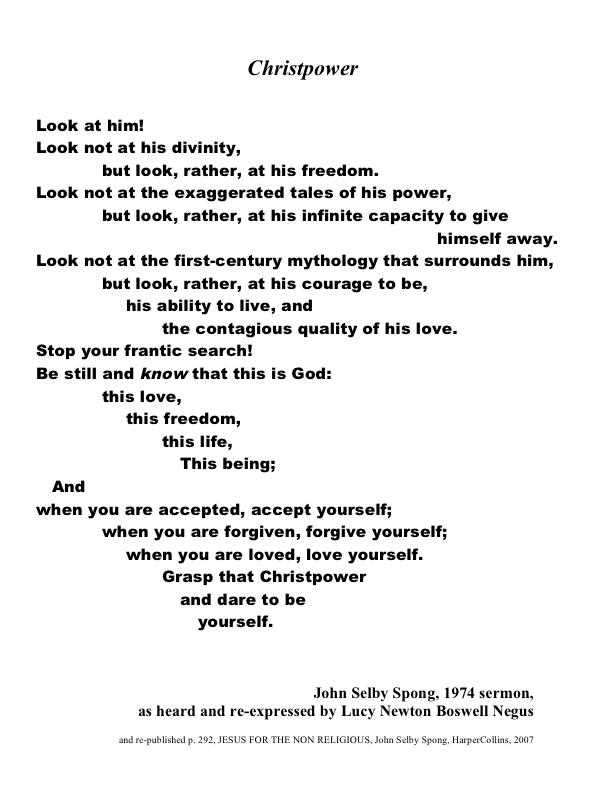
John Shelby Spong’s own upbringing was very “biblical.” In the course of his life, he says, his Christianity has been transformed, and clearly the power of Jesus in his life remains strong. My single most powerful moment last week came with the reading of Spong’s epilogue, “Christpower.” Here’s the poem expressing his core religious belief:

As George Fox said:

For looking down at sin, and corruption, and distraction, you are swallowed up in it;

[one aspect of Buddha’s “suffering”?]

but looking at the light that discovers them, you will see over them.

Thank you, dear friends.
Blessed be.

Posted in 'Divine Action', Guidance | Tagged | 3 Comments